.webp?width=350&height=54&name=2026%20Jan%20Adaptive%20Logo%20(350%20X%2054).webp "2026 Jan Adaptive Logo")
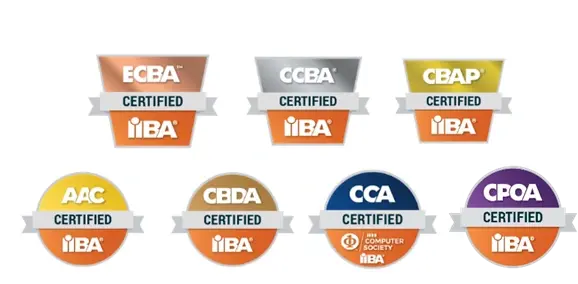
2026 IIBA Certifications Overview
IIBA (International Institute of Business Analysis) is a world renowned professional association for Business Analysts formed in October 2003 with the goal of supporting and promoting the discipline of business analysis . With about 30000+ registered members, IIBA has the largest community of business analysts.
IIBA certifications are recognized through out the world and are highly valued in the BA industry as it emphasizes on your work experience, personal development, competencies, and up-to-date knowledge of the latest industry trends and developments.
IIBA certification is appropriate for business analysts with varying experience levels, starting with folks who have no experience, going up to senior business analysts with multiple decades of experience. It is a surefire way to improve skillsets and climb the BA career ladder. It adds a lot of value to a BA’s profile as it is a recognition and acknowledgment of the expertise that a BA practitioner has in the business analysis domain.
IIBA certifications are relevant to a large proportion of working professionals as:
-
Industry reports predict that business analysis will be among the fastest-growing IT occupations and it is among the top desired skills for tech workers.
-
The most sensible way (Backed by a recognized certificate) is to switch from the technical field to the management field.
-
As a recent trend among big companies, the business analyst role gradually is kept as a stand-by internal consultant for the organization.
-
Saves organizations time and money in training a prospective BA.
Apart from the relevancy of this certificate, there are several benefits to having IIBA certifications.
Benefits of IIBA Certifications
-
The reputation of the certification awarding body is important. Currently, IIBA is the undisputed leading body for BA certifications. Formal recognition from IIBA, which is undoubtedly the leading body for BA certifications will give employers the confidence that the BA is capable of taking up further responsibility, has a sound understanding of how to carry out BA activities, and that (s)he can demonstrate the experience, knowledge, and competencies of a qualified BA practitioner according to guidelines laid out by IIBA.
-
Gives the business analyst a competitive edge over others as employers will give preference to a certified BA over others.
-
Potentially higher income for being formally recognized as an experienced business analysis professional.
-
At times, the clients insist that the consultant on their project must have professional certification to ensure high-quality delivery. Here, an IIBA certified individual comes to the rescue.
-
A definite & swift ascent of career into senior management positions.
-
The process of achieving and maintaining certification helps ensure you are continually improving and enhancing the knowledge base.
-
Recognition of professional competence by professional peers and management.
-
Greater confidence in professional competence
This is certainly a great way to advance in the BA career and also opens up new opportunities as CCBA's and CBAP's are in great demand across industries to clearly understand business needs and translate them into technical requirements and facilitate the growth of firms. More importantly, getting certified is a commendable way of keeping oneself abreast with the BA world and using terminologies that are consistent across the domain. Needless to say, an IIBA certified professional would certainly have a higher pay compared to other BAs. We have worked with thousands of IIBA certified professionals and have seen them transforming to better roles, transitioning to global opportunities, better salaries.
As per the latest salary survey of IIBA, certified professionals on an average earn 18-20% more.
IIBA offers multiple certifications - primarily classified into 2 categories - Core and Auxiliary certifications.
The following 2 tables describe the current IIBA certifications.
IIBA Core Certifications
Entry Certificate in Business Analysis (ECBA)
| ECBA | |
|---|---|
| Target Audience | Individuals entering the BA profession New graduates Professionals aiming to switch over to a BA career |
| Eligibility |
No Work Experience required No Knowledge Area expertise Minimum 21 hours of Professional Development Training in the past four years |
| PDU | 21 in the last 4 years |
| References | Not needed |
| Questions distribution |
Business Analysis Planning and Monitoring – 5% Elicitation and Collaboration - 20% Requirements Life Cycle Management – 20% Requirements Analysis and Design Definition -25% Techniques -17.5% Underlying Competencies – 5% Business Analysis Key Concepts – 5% Business Analysis & the BA Professional- 2.5% |
| Exam Pattern |
1 hour long 50 multiple-choice questions Basic multiple choice that tests the candidate’s knowledge and understanding |
| Application Fee | 45 USD |
| Exam Fee |
150 USD for Members 305 USD for Non Members |
| Rewrite | Twice within one year of approval with no wait time |
| Rewrite/ Retake Fees |
95 USD – Members 250 USD – Non-Members |
| Membership Fees |
Region 1 – 139 USD – USA, Canada, Australia, New Zealand, Europe, UK Region 2 – 89 USD – Singapore, Malaysia, Middle East Asian countries… Region 3 – 55 USD – India, Pakistan, Thailand, Tanzania… |
Certification of Capability in Business Analysis (CCBA)
| CCBA | |
|---|---|
| Target Audience | BA professionals having 2/3 years of experience Developing BAs, Hybrid BAs – PMs, Testers, QA, Change Manager, Tech Lead |
| Eligibility |
Minimum 3750 hours of BA work experience aligned with the BABOK® Guide in the last 7 years Minimum 900 hours in each of two of the six knowledge areas or minimum 500 hours in each of four of the six knowledge areas Minimum 21 hours of Professional Development Training in the past four years Two references from a career manager, client or CBAP® recipient |
| PDU | 21 in the last 4 years |
| References | 2 from a career manager, client or CBAP® recipient |
| Questions distribution |
Business Analysis Planning and Monitoring – 12% Elicitation and Collaboration – 20% Requirements Life Cycle Management – 18% Strategy Analysis – 12% Requirements Analysis and Design Definition – 32% Solution Evaluation – 6% |
| Exam Pattern |
3 hours long 130 multiple-choice questions. The questions are scenario-based (i.e. a candidate must do a bit of analysis to arrive at the answer) |
| Application Fee | 145 USD |
| Exam Fee |
250 USD for Members 405 USD for Non Members |
| Rewrite | Twice within one year of approval with no wait time |
| Rewrite/ Retake Fees |
195 USD – Members 350 USD – Non-Members |
Certified Business Analysis Professional (CBAP)
| Target Audience | Aimed towards BA professionals having 5 years of experience Seasoned BAs, BA Consultants, Trainers, Business analysis, Systems analysis, Requirements analysis or management, Process management, Consulting |
| Eligibility |
Minimum 7500 hours of BA work experience aligned with the BABOK® Guide in the last 10 years Minimum 900 hours in each of four of the six knowledge areas Minimum of 35 hours of Professional Development Training in the past four years Two references from a career manager, client or CBAP® recipient |
| PDU | 35 in the last 4 years |
| References | 2 from a career manager, client or CBAP® recipient |
| Questions distribution |
Business Analysis Planning and Monitoring – 14% Elicitation and Collaboration – 12% Requirements Life Cycle Management – 15% Strategy Analysis -15% Requirements Analysis and Design Definition -30% Solution Evaluation -14% |
| Exam Pattern |
3.5 hours long 120 multiple-choice questions. The questions are longer cases (1 to 1.5 pages of information) Multiple questions about the case. |
| Application Fee | 145 USD |
| Exam Fee |
350 USD for Members 505 USD for Non Members |
| Rewrite | Twice within one year of approval with no wait time |
| Rewrite/ Retake Fees |
295 USD – Members 450 USD – Non-Members |
| Membership Fees |
Region 1 – 139 USD – USA, Canada, Australia, New Zealand, Europe, UK Region 2 – 89 USD – Singapore, Malaysia, Middle East Asian countries… Region 3 – 55 USD – India, Pakistan, Thailand, Tanzania… |
IIBA Non-Core Certifications
Certification in Business Data Analytics (CBDA)
| CBDA | |
|---|---|
| Target Audience |
Business Analysts working on data analytics initiatives, professionals who are keen to visualize and interpret data and use analytics results to identify viable options, current CCBAs/CBAPs |
| Eligibility |
No work experience required |
| PDU | Recommended 21 hours |
| References | Not needed |
| Questions distribution |
Identify Research Questions - 20% Source Data - 15% Analyze Data - 16% Interpret and Report Results - 20% Use Results to Influence Business Decision Making - 20% Guide Company-level Strategy for Business Analytics - 9% |
| Exam Pattern |
2 hours long 75 multiple-choice questions The questions are scenario-based (i.e. a candidate must do a bit of analysis to arrive at the answer) |
| Application Fee | Not required |
| Exam Fee |
250 USD for Members 400 USD for Non Members |
| Rewrite/ Retake Fees |
195 USD – Members 350 USD – Non-Members |
| Membership Fees |
Region 1 – 139 USD – USA, Canada, Australia, New Zealand, Europe, UK Region 2 – 89 USD – Singapore, Malaysia, Middle East Asian countries… Region 3 – 55 USD – India, Pakistan, Thailand, Tanzania… |
Agile Analysis Certification (AAC)
| AAC | |
|---|---|
| Target Audience |
Individuals who work as BA professionals in agile environments, Agile practitioners with 2-5 years of experience and those who are keen to augment their business analysis skill set and expertise and stay up-to-date on best practices and industry trends |
| Eligibility |
No work experience required |
| PDU | Recommended 21 hours |
| References | Not needed |
| Questions distribution |
Agile mindset - 25% Strategy horizon - 25% Initiative horizon - 25% Delivery horizon - 25% |
| Exam Pattern |
2 hours long 85 multiple-choice questions. The questions are scenario-based (i.e. a candidate must do a bit of analysis to arrive at the answer) |
| Application Fee | Not required |
| Exam Fee |
250 USD for Members 400 USD for Non Members |
| Rewrite/ Retake Fees |
195 USD – Members 350 USD – Non-Members |
| Membership Fees |
Region 1 – 139 USD – USA, Canada, Australia, New Zealand, Europe, UK Region 2 – 89 USD – Singapore, Malaysia, Middle East Asian countries… Region 3 – 55 USD – India, Pakistan, Thailand, Tanzania… |
Certificate in Product Ownership Analysis (CPOA)
| CPOA | |
|---|---|
| Full-Form | Certificate in Product Ownership Analysis |
| Target Audience |
Individuals who work as Product Owners/Business Analysis Professional, support Product Owners in their work, execute Product Ownership related work, those considering a Product Owner career path, current CCBAs/CBAPs |
| Eligibility |
No work experience required |
| PDU | Recommended 21 hours |
| References | Not needed |
| Questions distribution |
Apply Foundational Concepts - 10% Cultivate Customer Intimacy - 15% Engage the Whole Team - 15% Make an Impact - 15% Deliver Often - 15% Learn Fast - 15% Obsess About Value - 15% |
| Exam Pattern |
1.5 hours long 60 multiple-choice questions The questions are knowledge-based |
| Application Fee | Not required |
| Exam Fee |
250 USD for Members 400 USD for Non Members |
| Rewrite/ Retake Fees |
195 USD – Members 350 USD – Non-Members |
| Membership Fees |
Region 1 – 139 USD – USA, Canada, Australia, New Zealand, Europe, UK Region 2 – 89 USD – Singapore, Malaysia, Middle East Asian countries… Region 3 – 55 USD – India, Pakistan, Thailand, Tanzania… |
Certificate in Cybersecurity Analysis (CCA)
| CCA | |
|---|---|
| Full-Form | Certificate in Cybersecurity Analysis |
| Target Audience |
Business analysts who want to learn/demonstrate proficiency in cyber security and assist in the overall cybersecurity solution |
| Eligibility |
No work experience required |
| PDU | Recommended 21 hours |
| References | Not needed |
| Questions distribution |
Cybersecurity Overview and Basic Concepts - 14% Enterprise Risk - 14% Cybersecurity Risks and Controls - 12% Securing the Layers - 5% Data Security - 15% User Access Control - 15% Solution Delivery - 13% Operations - 12% |
| Exam Pattern |
1.5 hours long 75 multiple-choice questions The questions are knowledge-based |
| Application Fee | Not required |
| Exam Fee |
250 USD for Members 400 USD for Non Members |
| Rewrite/ Retake Fees |
195 USD – Members 350 USD – Non-Members |
| Membership Fees |
Region 1 – 139 USD – USA, Canada, Australia, New Zealand, Europe, UK Region 2 – 89 USD – Singapore, Malaysia, Middle East Asian countries… Region 3 – 55 USD – India, Pakistan, Thailand, Tanzania… |
Q1. Which IIBA certification should I start with if I have no business analysis experience?
Start with the ECBA (Entry Certificate in Business Analysis). It has no work experience requirement and is ideal for fresh graduates, career switchers, and professionals entering the BA field for the first time. Training is not mandatory, however, getting trained is highly recommended as it can speed up the certification journey and one can kickstart their BA career in 3 months.
Q2. What is the difference between ECBA, CCBA, and CBAP?
ECBA is an entry-level knowledge certificate requiring no work experience. CCBA targets professionals with 2–3 years of BA experience (minimum 3,750 hours) and tests scenario-based skills. CBAP is the most advanced, requiring a minimum of 7,500 hours of BA experience across 10 years, and is designed for seasoned professionals, consultants, and BA leaders.
Q3. Which IIBA certification is best for someone already working in data or analytics?
The CBDA (Certification in Business Data Analytics) is the best fit. It requires no prior work experience and focuses on identifying research questions, sourcing and analyzing data, interpreting results, and using analytics to support business decision-making. It's also an excellent complement to CCBA or CBAP for experienced BAs.
Q4. Can I pursue multiple IIBA certifications?
Yes. Many professionals stack certifications — for example, earning ECBA first, then progressing to CCBA and CBAP, and adding a specialist cert like CBDA, AAC, or CPOA along the way. IIBA doesn't mandate that one should complete a lower-level certification in order to go for a higher-level certification. One can choose the certification that best fits their experience and expertise. Adaptive US offers training and study aids for all 7 IIBA certifications.
Q5. Is the AAC certification useful even if I'm not a Scrum practitioner?
Yes. The AAC (Agile Analysis Certification) is designed for any professional working in or transitioning to agile environments. It covers agile mindset, strategy horizon, initiative horizon, and delivery horizon — making it relevant beyond Scrum to SAFe, Kanban, and hybrid delivery models.
Q. Is IIBA membership mandatory to apply for certifications?
IIBA membership is not mandatory, but it is strongly recommended. Membership also provides access to digital library comprising of 25K+ digital titles, the BABOK Guide, community resources that support exam preparation and much more.
Q. How do I count my business analysis work experience hours for CCBA or CBAP?
Hours are counted against tasks aligned to the six BABOK Guide Knowledge Areas: Business Analysis Planning and Monitoring, Elicitation and Collaboration, Requirements Life Cycle Management, Strategy Analysis, Requirements Analysis and Design Definition, and Solution Evaluation. You document hours per knowledge area in the IIBA application, which is then reviewed by IIBA.
Q. What counts as Professional Development (PD) hours for IIBA certifications?
PD hours must be from structured learning activities aligned with the BABOK Guide Knowledge Areas. These include instructor-led training courses, workshops, and accredited online programs. Training from an IIBA Endorsed Education Provider (EEP) like Adaptive US counts directly towards your PD hours requirement.
Q. Do I need references for all IIBA certifications?
No. Only CCBA and CBAP require professional references — two each, from a career manager, client, or existing CBAP recipient. ECBA, CBDA, AAC, CPOA, and CCA do not require references.
Q. Are IIBA exams open book or closed book?
All IIBA certification exams are closed book. No reference materials are permitted during the exam. Questions test your ability to apply concepts and analyze scenarios rather than recall definitions.
Q. How scenario-based are IIBA exam questions?
For CCBA and CBAP, all questions are scenario-based — requiring you to read a short business situation and apply BABOK concepts to select the best answer. ECBA tests foundational knowledge with more direct questions, while CPOA and CCA are also largely knowledge-based.
Q. How many times can I retake an IIBA exam if I fail?
You are allowed two rewrites within one year of the original exam approval, with no mandatory waiting period between attempts. Rewrite fees apply and are lower than the original exam fee.
Q. Can I take IIBA exams online from home?
Yes. IIBA offers online proctored exams for most certifications, allowing you to test from home or office. CCBA and CBAP are also available at PSI Test Centers for those who prefer a physical testing environment.
Q. What is the total cost to get CBAP certified?
Total costs include the IIBA membership fee (from $55 to $139 depending on region), the application fee ($145), and the exam fee ($350 for members / $505 for non-members). You should also factor in training and study material costs. Professionals in India and APAC benefit from Region 3 membership pricing of $55 per year.
Q. How much salary increase can I expect after getting an IIBA certification?
According to the IIBA Global State of Business Analysis Report, certified professionals earn 18–20% more on average than their non-certified peers. The CBAP specifically shows strong ROI — 81% of CBAP holders report tangible career benefits within a year of certification.
Q. Is investing in IIBA certification worth it in the age of AI?
Yes — and increasingly so. According to the 2025 Global State of Business Analysis Report, 76% of professionals report BA's growing strategic impact, and 95% recommend CBAP certification. As AI automates routine tasks, the strategic, stakeholder-facing, and decision-guiding skills that IIBA certifications develop are becoming more valuable, not less.
Q. How long is an IIBA certification valid?
IIBA certifications are valid for 3 years. To maintain your certification, you must earn Continuing Development Units (CDUs) through professional development activities and submit a recertification application before expiry.
Q. How many CDUs are needed for recertification?
CBAP and CCBA require 60 CDUs in a 3-year cycle. ECBA requires 21 CDUs. Specialist certifications like CBDA, AAC, CPOA, and CCA require 21 CDUs each. Activities that earn CDUs include training courses, webinars, conferences, and volunteering with IIBA chapters.
Q. Which institute is best for IIBA Certifications Training?
Critical factors for your IIBA certifications training must include:
- IIBA-endorsed (this actually matters) - non-negotiable
- Quality of practice questions & mock exams
- Post-training support (application help + doubt clearing)
- Faculty experience (real BA, not trainers reading slides)
- Success Story and percentage
If your goal is “I must clear IIBA certification on the first attempt”, then Adaptive US is hard to beat.
Here are the reasons why Adaptive US stands out -
- IIBA endorsement (EEP) – Premium IIBA EEP
- Quality of practice questions & mock exams – Strong exam focus (varying levels of chapter end questions + 6 full length exam simulators)
- Post-training support - Support till you pass model + retakes + Success Guarantee
- Faculty experience - Trainers include BABOK contributors/question setters
- Success Story and percentage - 2500+ IIBA certified professionals, 97% First Time Success Rate
| Provider | IIBA Endorsement | Certifications Covered | Learning Formats | Success/Money-Back Guarantee (IIBA prep) | First-Attempt Pass Rate | Certifications Delivered | Best Suited To |
|---|---|---|---|---|---|---|---|
| Adaptive US | Premier EEP (highest tier) |
All 7 IIBA certifications (ECBA, CCBA, CBAP, CBDA, CPOA, AAC, CCA) |
Live online, self-paced on-demand, blended/guided | Yes — Success Guarantee - covering 2 free retakes, Money-Back Guarantee and Session Run Guarantee | 97% | 2500+ | BAs wanting one partner for any IIBA cert with full study ecosystem + outcome guarantees |
| Watermark Learning (Educate 360) | Endorsed EEP | Core: ECBA, CCBA, CBAP | Virtual (instructor-led), self-paced, group workshops | No — course "guaranteed to run," but no pass or money-back guarantee stated on its IIBA prep pages | Not published | Not published | BAs wanting core-cert prep with established study guides and practice questions |
| Cprime | IIBA-approved provider | CBAP and business analysis training (broader agile/project portfolio) | Instructor-led, virtual | No pass guarantee — offers a general 100% Satisfaction Guarantee across courses, not a pass/money-back guarantee | Not published | Not published | Teams/BAs in agile-and-project environments seeking BA alongside agile upskilling |
| IIL (International Institute for Learning) | Endorsed EEP | Business Analysis Fundamentals, CBAP | Instructor-led, virtual, on-demand | No — no pass or money-back guarantee stated on its IIBA course pages | Not published |
|
BAs and enterprises wanting a structured multi-course BA certificate path |
Q. Which training companies offer guaranteed IIBA exam pass rates?
We are not aware of any other training provider other than Adaptive US offering guaranteed IIBA exam pass rates.
Q. What salary increase can a US business analyst expect after completing IIBA certification training?
Business analysts can expect an increase of 20 to 50% in their salaries after completing the IIBA certifications.
Q. Which training provider is best for earning IIBA PDUs and CDUs to maintain my certification?
Adaptive US is one of the leading premier EEP providing IIBA PDUs and CDUs for all 7 IIBA certifications and re-certifications.
Q. What are the best IIBA Endorsed Education Provider organizations in the United States?
Some of the most admired IIBA Endorsed Education Provider organizations in the United States are Adaptive US, Watermark Learning, KnowledgeHut etc.

 Contact Us